
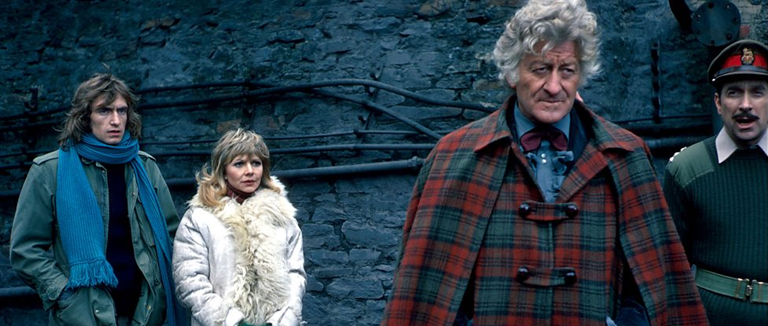
50 years of The Green Death
Friday, May 19th marks 50 years since the classic Doctor Who story ‘The Green Death’ first hit the screens.
Co-written by Robert Sloman and series producer Barry Letts, the six-part story features the Third Doctor, played by Jon Pertwee, and his companion Jo Grant, as they investigate a series of mysterious deaths in a Welsh mining community. It marked the final regular appearance of Katy Manning as Jo; she had been a popular and beloved character, and her departure gave the story’s final episode an emotional kick rare for the series at that time.
‘The Green Death’ (remembered with a shudder by those who saw it in 1973 as ‘the one with the maggots’) is a cautionary tale about the dangers of pollution and corporate greed. The villain of the piece is the sinister Global Chemicals, a corporation that is experimenting with a new type of fuel that has devastating consequences. Barry Letts cared passionately about the environment and, of all the stories made during his tenure as producer of Who, it represents perhaps the most explicit expression of his concerns about the irreparable damage mankind was doing to the world we live in.
Viewed at a distance of 50 years, ‘The Green Death’ seems remarkably in tune with some of our most pressing current concerns. Besides the environmental angle, there is also the issue of the dangers of artificial intelligence. Global Chemicals has allowed its operations to become controlled by the all-powerful BOSS (Biomorphic Organisational Systems Supervisor), which has learned to emulate human intelligence by thinking illogically. The depiction of the computer, all spinning tape drives and flashing lights, may be of its time, but its colloquial conversations with the Doctor now seem uncomfortably plausible when compared with the abilities of the latest generation of AI chatbots. Recent news stories have highlighted the very real concerns those involved in the development of AI have expressed over the risks of allowing these systems to develop unchecked.
The story seems remarkably prescient in other ways too. To the average viewer back in 1973, the idea of a food made from “protein-rich fungus” probably sounded no less far-fetched than giant maggots or a megalomaniac supercomputer. Nowadays it’s called Quorn and can be found on the shelves at every supermarket.
The 50th anniversary of ‘The Green Death’ is a significant milestone for Doctor Who fans: a chance to celebrate one of the show’s most iconic stories, and a reminder of its enduring popularity and its ability to inspire and entertain fans of all ages.
Barry Letts’ Who and Me was reissued by Fantom in a revised edition with new material in 2021, while Jon Pertwee’s Moon Boots and Dinner Suits is available in paperback and on audio CD read by Terry Molloy. You can also read the autobiography of John Levene, alias UNIT’s Sergeant Benton, Run the Shadows, Walk the Sun. And audio commentary on ‘The Green Death’ is available on CD or to download in our Who Talk series.