
Turning to stone
The summer solstice on 21st June will be marked by ceremonies at stone circles up and down the UK.
Circles of standing stones hold significant cultural and historical importance, particularly in relation to celestial events like the summer solstice. It marks the longest day of the year in the Northern Hemisphere, when the sun reaches its highest point in the sky and daylight hours are at their peak. Stone circles were constructed by ancient civilisations as ceremonial and astronomical sites, and they often aligned with the movements of the sun, moon, and stars.
Many stone circles are believed to have been intentionally designed to align with the rising or setting sun on the summer solstice. For example, the most famous stone circle, Stonehenge in Wiltshire, aligns with the sunrise on this day. During this alignment, the sun’s rays pass directly through the monument’s carefully positioned stones, creating a dramatic effect. Stonehenge and similar stone circles served as calendars and observatories for ancient people, allowing them to track and understand the passage of time, seasons, and astronomical events.
This cosmic alignment is closely tied to ancient rituals, beliefs, and cultural practices. It would have been seen as a sacred and awe-inspiring event, and likely played a role in religious or ceremonial practices of the time. Many civilisations regarded the solstices as important moments in the annual cycle, associated with the renewal of life, fertility, and the power of the sun.
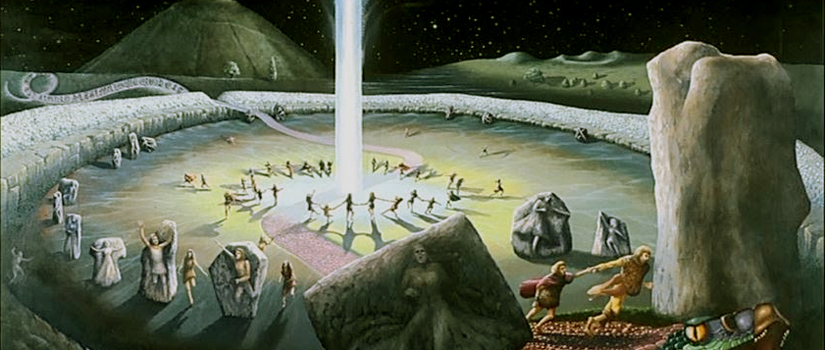
Stone circles have captivated human imagination for centuries due to their enigmatic nature and the sense of mystery surrounding their origins and purpose. This intrigue has translated into popular culture, including TV science fiction, where stone circles are often depicted as places of mysterious power. For example, in the Doctor Who story ‘The Stones of Blood’, a group of standing stones on a moor in Cornwall are revealed to be a race of silicon-based, blood-feeding life forms called Ogri. And in the classic 1970s serial Children of the Stones – described by comedian Stewart Lee as ‘the scariest programme ever made for children’ – the astronomer Hendrick uses a stone circle to harness the energy of a black hole, in order to brainwash the local villagers into becoming zombie-like ‘Happy Ones’.
This latter example, in particular, illustrates how stone circles are often portrayed in TV science fiction as gateways to other dimensions, conduits of mysterious energies, or sites of ancient and potent magic. Their association with the unknown, combined with their real-world historical significance, makes them compelling settings for stories that explore the intersection of science and the mystical.
The novelisation of Children of the Stones by Jeremy Burnham and Trevor Ray is available from Fantom in paperback, and also as an audiobook read by Gareth Thomas who starred in the TV series. You can also order Jeremy Burnham’s long-awaited sequel Return to the Stones in paperback. And commentary on the Doctor Who story ‘The Stones of Blood’ is available in our Who Talk series, moderated by Toby Hadoke and featuring members of the cast and crew including John Leeson (the voice of K9) and the serial’s director, Darrol Blake.
