
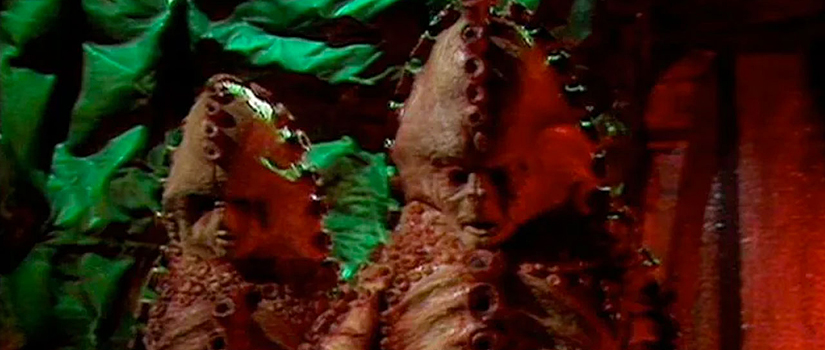
Waving a tentacle
Happy 48th birthday to the Zygons, who made their first appearance on our screens on this day in 1975! 30th August in that year saw the transmission of the first episode of ‘Terror of the Zygons’, the opening story of Doctor Who’s 13th season.
Since the start of the 1970s, new seasons of Doctor Who had always begun in winter. However, Gerry Anderson’s new science-fiction spectacular Space: 1999 was due to launch in September 1975 and run until the following February, and there were concerns that Who would not fare well if it came to our screens two-thirds of the way through the debut run of its glossier rival. So the decision was made to bring the new season to air earlier than planned, and ‘Terror of the Zygons’ – originally intended as the finale to Season 12, and closing a number of that season’s plot arcs – was rescheduled to kick-start Season 13.
The story was the work of writer Robert Banks Stewart, creator of such hit detective series as Shoestring and Bergerac. Although initially unwilling to write for Doctor Who as he didn’t feel his style of writing lent itself to stories set on alien worlds, he relented when he realised that not only could he write an adventure set on Earth, but that he could locate it in his native Scotland and make use of the legend of the Loch Ness Monster. In the story, ‘Nessie’ is actually a cyborg sea creature, the Skarasen, controlled by the Zygons who are alien shapeshifters plotting to take over the Earth after they discover their home planet has been destroyed. Intertwining the fabled creature of Loch Ness with extraterrestrial involvement allowed Stewart to create an alluring blend of science fiction and folklore.
Script editor Robert Holmes liked Banks Stewart’s concept, but was concerned that too much screen time was given to the Skarasen, which not only would be difficult to render convincingly in terms of special effects but also, as a mute monster, would be impossible for the Doctor and his associates to engage with. With Holmes’s encouragement, Banks Stewart reworked the story to make the Zygons the primary antagonists – and a legendary Doctor Who foe was born.
In recent years, the story’s cult following has grown, with fans appreciating its nostalgic value and its contribution to Doctor Who lore. Much of its success is down to veteran Who director Douglas Camfield, whose expertise shines through in the visual storytelling. He skilfully employs camera angles, lighting, and shot composition to create an atmospheric and suspenseful tone.
Modern audiences are able to view the story with an understanding of the limitations of 1970s television production, in particular with regard to the realisation of the Skarasen. Despite this, the Zygons’ unique design and menacing presence contribute greatly to the story’s overall appeal. They are not just villains; their predicament as refugees adds complexity to their motives. Although the Zygons only appeared in that one story during the programme’s original run, their brilliant realisation in terms of costume and make-up helped to ensure their iconic status among Who fans; and it was inevitable that they would eventually reappear, with only minimal design changes, in the revived series.
‘Terror of the Zygons’ is a marker of a time of change in Doctor Who, and in particular the last hurrah for the ‘UNIT family’. RSM Benton would only appear in one further story, ‘The Android Invasion’, later in that season, while Brigadier Lethbridge-Stewart would not be seen again for another eight years. It was also the last regular appearance of companion Harry Sullivan, although he too, like Benton, would pop up in ‘The Android Invasion’.
The production of ‘Terror of the Zygons’ is discussed in detail in Michael Seely’s biography Directed by Douglas Camfield, available now in hardback from Fantom. Also in hardback is Run the Shadows, Walk the Sun, the autobiography of John Levene, aka RSM Benton; and John can be heard discussing Episode 3 of ‘Terror of the Zygons’ in Who Talk: ReU.N.I.T.ed, part of our series of audio commentaries moderated by Toby Hadoke.